Thursday, May 23, 2013

Containing the Hive, trucking through the Heartland, and Innovating through history

After taking a break for a week (sometimes "real life" gets in the way....sigh) I was back at the Game Parlor this past Tuesday looking for some gaming action.  Actually, nearly all of our "regular" group passed on this week as well...with the exception of Carson, who was running late.  That left me looking to join in some games with other folks at the store.  Unfortunately, it seemed to be a low turnout in general...but just as I was considering leaving, a fellow named Darren with whom we've played in the past came in, and asked if I was looking for a game.

Tower o' beetles!
Since I knew Carson would be arriving at some point, we decided on a quick 2-player game.  Darren introduced me to Hive, a clever little tile laying game.  The idea in Hive is to completely surround your opponent's queen bee - with tiles from either side.  So, you have to be careful not so endanger your own queen with your own tiles.  At the start of the game, each player lays down one tile, and they must touch.  Your queen must be one of the first 4 tiles you place, and you cannot place where it touches an opponents tile.  However, once your queen is placed, your hive becomes active, and your already placed tiles can move - and they can move to touch the opponents tiles.  There are several different bugs, and they all have different movement rules...but the key rule to the game is that the hive can never split, i.e. you cannot perform a move such that a single tile, or group of tiles becomes separated from the main hive.  This leads to useful defensive strategies like hanging an ant off the end of a key tile of your opponent such that they can't move that tile.  Despite the kind of silly theme, this is an interesting and deep game, and very chess-like.

Breaker 1 - 9, anyone got leads on Smokey the Bear?
 Carson arrived after we'd played a few games of Hive, and I spotted something in Darren's collection that I've been wanting to try for some time now - Dice Hate Me Game's The Great Heartland Hauling Company.  In this game, you play the role of a trucker hauling various resources (pigs, cattle, corn, soy) to and fro across the "Heartland", trying to sell the goods and make a profit - game end is triggered when one player reaches a certain dollar amount (i.e. score) - which is dependent on the number of players.  The game "board" is going to be unique every time, as it is created by placing a number of cards around a central "anchor" card.  Each of the cards has a primary resource that you can pick up, and 2 resources which they will buy for an annotated price - some places pay more for certain goods than others.  In the basic game, you essentially just make a grid of these cards, but you can set them in any design you want, really (which can make it more difficult).  You navigate across the map, and manipulate the resources on your truck by means of a 2nd deck of cards, from which you are constantly drawing up to a hand of 5 (Ticket to Ride style, where you can draw from face up cards, or randomly from the top of the deck).

This map configuration was...challenging...
On your turn, you must do 3 things, in this order - move, take an action, and then draw up to a full hand for next turn.  In order to move, you either play fuel cards from your hand (in values of 1, 2 or 3 which allow you to move that many cards), or if you have no fuel cards, you can pay $1 per space you want to move, up to 3 spaces.  You can pass through a card with another player, but you may not stop there.  On your action phase you can do one of three things - pick up goods, deliver goods, or pay money to discard and redraw new cards.  In order to pick up or deliver goods, you must play a card of that good type - one card per good.  And you can not mix goods.  As the game goes on, goods will end up on cards where they are not the prime resource...you can pick those up, at a cost of 2 cards per good.  Now, I want to highlight what I think is the key mechanic in this game.  You MUST move BEFORE picking up or delivering.  What this means, in essence, is that you cannot deliver a good to a spot, and then on your next turn pick up the good that they are "selling" there, to then deliver to another location.  So, you have to plan several turns in advance as you collect cards in your had, and what route you may take.  To be honest, I don't know how I feel about this rule.  It sort of breaks the theme for me...in that in real life, you typically wouldn't offload in one city, and then drive your empty truck over to the next city to load up on goods there.  I suspect that in original playtests of the game, you could pick up where you had dropped off, but I suspect that made the game pretty easy...it's definitely more strategic this way.

We played a 2nd game of "TGHHC", in which we used some expansion cards - two cards were locations that only bought goods, and didn't provide any - but they bought at premium prices.  The other cards we used were "truck stops", which were essentially cards that you could buy if you landed on them, which would allow you to break the rules of the game if they were in your possession.  For example, I ended up with a card called "sleeper cab", which enabled me to spend $1 to NOT move on a turn.  Unfortunately, I was never able to put that to really good use.  There are some other alternate rules that we didn't play such as road closures.  In short...I don't think I liked this game as much as I wanted to.  The whole thing about not being able to pick up in the same place as you just delivered was a real irritant.  On the other hand, I would like to play some more, using those truck stop cards...I think those push the game up a level.  And I really really liked the little 18-wheeler meeples (18-wheeleeples?) - I might have to pick up a copy just for those!


Moving into Age 3....
 Lastly, we played a 3 player game of Innovation.  In this card game, you are trying to build your civilization on various technical advances through 10 different ages.  There are 10 decks of card that represent the different ages.  You start with a hand of 5 (I think) cards, and on your turn, you can do one of the 3 things - "Meld", which is playing a card from your hand face up in front of you, on top of any cards of the same color, "Draw" - drawing a new cards equal to or possibly exceeding the highest "age" card you've played, or "Dogma", which essentially allows you to use the text of any card you have face up in front of you.  The cards are used for multiple purposes - they are used for their dogma powers, they all have symbols on them, which may allow you use another player's dogma actions, and they are used as points...which are then used to "buy" achievements - first player to 5 achievements wins the game.  The "dogma" actions are what really drive the game, and allow you to alter your various face-up cards, score points, screw with your neighbors (and boy can that happen a lot), etc.  I was really enjoying this game for about the first 3/4...and then it (literally) blew up.  Carson had fallen far behind.  Darren and I had multiple achievements, and he had none so far.  With much apologies, he decided to play the "Fission" card, which wiped out the face-up decks, and the points of every player on the board - and removed those cards from the game.  Darren and I still had our achievements, but with only a handful of Age 1 and 2 cards, and then leaping up to Age 8+, it was a strange climb back into the game.  It quickly became obvious that we weren't going to win by getting to 5 achievements, and the alternate rule is that when the Age 10 deck runs out, the person with the most points win.  But those higher age dogma effects get to be pretty crazy - one of them changed the winning condition to the player with the *least* amount of points.  And the "screw your neighbor" aspect ratchets up with those higher age cards.  In the end, Darren won by running out the Age 10 deck.  So...I don't know how I feel about this game...I want to play it again.  I think that the "fission" card may be a game breaker...but it did allow Carson to get back in the game (he actually tied for the win, but lost on tie breaker).  And I think those higher age cards may be a little too much "screw your neighbor"...but after one play, I'm not sure I can judge that so well.  There are games - like Dominion - that I knew after one play, weren't for me.  That's not the case with Innovation - I'm  a little wary...but I'd like to try it a few more times.


Thursday, May 9, 2013

Puerto Rico and "The Adventurers"


Well, we had a whopping 9 people stop in for Tuesday night boardgaming fun at The Game Parlor.  With that many people (which was actually lower than we had expected), we split into two groups.  Carson, Mike R., Mason and Brian D. played Ground Floor (which I have yet to play), and several rounds of the card game Hanabi.  The early birds among us were going to squeeze in a game of Hanabi, but the rest of the folks arrived earlier as well...it looks like an interesting card game in which you know everyone's cards...except your own.  The game is a cooperative endeavor to try and lay down cards of different colors in the correct order.  I'd definitely like to try it at some point.

In any case, our "sub-group" consisted of Mike BW, Tom, Traci, myself, and a fellow named Jeff who had wandered into the Game Parlor, looking for a game.  I decided to introduce this group to that old standby...Puerto Rico.  Mike, Tom & Traci had never played, and it had been a long time for Jeff.  A firm believer in "the burned hand teaches best", I set out to crush these newbies...in a fun, socially acceptable euro-game way of course.

Heading into the end game....
By random draw, I was the first Governor, which meant I got an indigo plantation.  Now, one of my favorite strategies to play is what my buddy Grant calls the "Corn King" strategy...plant lots of corn, ship it for points, and use a higher end crop (tobacco or coffee to generate money).  I thought I could pull of the same trick with Indigo.  I was wrong.  As the first Governor, I pulled a fairly standard move, and chose to settle, taking a quarry.  From there, it took me a long time to build up my Indigo empire...needing a production building as well as colonists in that building...it's far tougher to get those points rolling in than it is with corn.  I got my coffee going as well, and Jeff was the only other player in the coffee business...but by midgame I had an office, so I wasn't worried about getting shut out of the market.  Then game a couple of disastrous turns.  Jeff played the Captain role...and shipped his coffee...which meant I had to load my coffee on that boat...nothing left to sell in the market!  The Craftsman was played soon after, and I raked in 3 indigo, 2 coffee and a corn.  Next turn, when Captain was played, I had 3 people placing before me, and the boats consisted of corn(which was full), sugar and tobacco.  I couldn't place on any of the boats, and with no warehouse...I lost everything but one coffee.  We also had a turn where folks started taking the big buildings...a bit premature, I thought...and I opted for a wharf.  I never did get a big building.  Finally, the game ended about 3 or 4 turns earlier than a typical game, I think.  We had several rounds where 8, 9 or even 10 colonists got loaded on the ship...and lack of colonists did eventually end the game.  When the fog lifted from the island of Puerto Rico, I was left with 30, Mike, Jeff and Tom had between 32 and 36...and Traci had 51!  Shipping multiple loads of tobacco and corn, as well as 2 big buildings gave her a commanding win.  What was that about crushing the newbies?!?  I did learn a valuable lesson, that if I go for the "Corn King" strategy...it's best to use corn!


Here comes the boulder....
Jeff took his leave, and next up was The Adventurers: The Temple of Chac.  This is not to be confused with The Adventurers: The Pyramid of Horus, which is a "sequel" of sorts, but I think inferior to Chac.  This game is the "Indiana Jones" of board games.  As one of the adventurers, your goal is to escape the temple with the most expensive loot, while trying to avoid being killed by crushing walls, crumbling walkways over lava, a rickety bridge, a raging underground river, and most relentlessly...the ever pursuing boulder.  I was introduced to this game at WBC a few years ago, and love it - it's very light, very silly, and takes 45 minutes or less to play.  In fact, we got in 2 games of it. 

WILL HE MAKE IT?!?!
In our first game, I had the lockpicking ability, and tried saving it to use to pick up the "Idol of Chac", the most valuable treasure in the game.  Since it was everyone else's first game, most played conservatively, avoiding the lava, and just rushing for the exit.  I got sidelined at the rickety bridge getting that treasure (note that I have the 2nd edition, with includes a treasure on the bridge...I think this is a good thing, as it provides more impetus to actually cross the bridge.)  Mike BW managed to actually nab the Idol, and Tom, he and I made it out.  Traci did chance the lava after getting shut out of the wall treasures, and plunged to a fiery death.  As did her backup character, I believe.


Oh...so sad.....
The 2nd game was much more exciting.  Tom, Traci and I spent time among the crushing walls to study the glyphs for safe passage across the lava pit.  Mike made a dash for the wall treasures, and picked the locks on all 4.  The boulder was moving slowly.  I successfully made it across the lava pit, picking up several treasures.  Tom made for the exit, I think nabbing the bridge treasure.  I attempted to go for the idol, which I successfully recovered...however the boulder had picked up steam and was right on my heels.  I came charging around the corner, only to be caught by the boulder and squashed like a bug.  Mike and Traci had gone the river route.  Mike came out of the river with 9(!) treasures...but being loaded down, he was not moving fast.  Traci emerged shortly after him...only to be crushed mercilessly by the boulder.  Mike dropped 3 of his treasures to lighten his load, as he needed to move only 2 spaces to escape.  That meant that among the 5 dice to be rolled for movement, he only needed 2 of them to be 3 or above.  He promptly rolled, and got 1-1-2-2-4.  That meant only one move for him, right to the door itself...where it was promptly sealed by the boulder, using his crushed body as a nice gasket.

That was a fun game...and nice way to end the evening.  There are some rumblings to pull out Eclipse in the near future...which is something I've been wanting to play for some time....

Wednesday, May 1, 2013

Shadows Over Camelot & The Walking Dead

We got together for our usual Tuesday night adventures, and like last week, we had 6 of us - myself, Brian G, Mike R, Tom, Traci, and Carson made a return appearance after a few weeks away.  Unlike last week, we actually brought some games that accommodated more than 5 players.  After some debate we settled on that granddaddy of co-op games, Shadows Over Camelot.  We also opted to play with the expansion, Merlin's Company.  Published in 2005, while it may not have been the first cooperative game, SoC definitely invigorated the sub-genre of co-ops, and was possibly the first to add in the "traitor" element.  Merlin's Company adds in some cards to be drawn as you attempt to travel between quests, which may be a hindrance or beneficial.

Despair!
We randomly passed out loyalty cards, and also knight cards.  Alas, we were to fight against the dark forces without help from King Arthur himself!  We had a few knights bravely leave to search for the grail, Mike R. went to find Excalibur and I, as Sir Gareth, went to fight the marauding Picts.  Traci cast some suspicion on herself by remaining behind in Camelot for several turns and simply collecting cards.  Carson eventually joined me and helped me defeat the Picts, and after a somewhat long search, Brian claimed Excalibur.  That put a total of 3 white swords on the round table.  With many "despair" cards coming form the deck, the Grail looked to be lost at one point.  However, I had the "heroism" card, which added a white sword to any successful quest...that meant claiming the grail would be worth 4 white swords!  It took some time, but we were able to eventually find the grail!

The Grail has been found, and Merlin is warding off siege engines
Unfortunately, no one challenged Lancelot for his armor, and the Saxons overran our shores, which gave us several black swords.  At one point, we had 7 white swords and 4 black swords on the table.  Getting a 12th sword of any color would end the game.  But we were wary of the traitor, who if he remained unrevealed could flip 2 swords from white to black.  We also had a black card in action that would add an extra black sword to any failed quest.  Traci played a card that allowed the knights of Camelot to win the next tie...including the sword count at the end.  Mike R. was able to get rid of the "extra black sword card", and we were able to win a victory against the Saxons for an 8th and final white sword.  No one was accused during the game of being a traitor...well, no one was formally accused - there were certainly suspicious glances and mutterings about certain actions or non-actions.  But no one was confident enough to accuse a fellow knight of being a traitor...and for good reason - as it turned out, there was no traitor!  Battlestar Galactica tends to get the nod as the superior Coop-with-a-traitor game, but SoC is no slouch, and if you're in the mood for a coop game, this is a great game.


Next up, we pulled out The Walking Dead.  Mike R. is always quick to point out that this is the game based on the comics, not the TV shows (of which there is another game).  Basically, in this game, you are trying to be the first to successfully scout  3 locations on the map, based on location cards that are visible to everyone, and one secret location known only to you.  As you travel around, you leave hordes of zombies in your wake, and draw encounter cards, which can be zombie fights, or other tasks that require you to roll your dice pool.

It gets successively harder to scout each of your 3 locations.  In our game, Tom won in the end, although technically he "cheated", as he scouted the prison twice, and legally you can't scout the same location twice.  But that's OK, I think we were all ready for it to be over.  Now, I'm not a zombie fan(I really wish the whole zombie fad would star to die), so that's one strike against the game for me.  But that's not really what I have against the game.  It's fun in it's own way, but - and this is only my 2nd play - it can tend to drag a little.  By the time people have scouted their 2nd location, I feel like most people are ready to be done.  It didn't help that we had 6 players, which slows things down (although we allowed both Traci and Brian to "regenerate" after they were killed).  The other thing that is a little annoying is that it's impossible to plan for some of the encounter cards.  Sure, you can stock up on ammo and such to prepare for zombie encounters...but you may get a card that simply reads "you are successful at this encounter if you have the lowest amount of food - otherwise you fail".  Well...how can you possibly plan for that?  But, as was stated several times at the table, this game is all about atmosphere and story telling, and not really about strategy and tactics.

The zombies are starting to mass...Atlanta is a (un)death trap!


I did my part to stimulate the economy and help my FLGS by picking up a couple of items.  I did my usual walk around the Game Parlor, not expecting to really find anything, when lo and behold, there on the shelf sat the new 7 Wonders:Wonder Pack.  I had no idea such a thing existed.  So, for $15 I snatched it up.  Apparently the new Wonders are the Great Wall of China, Stonehenge, Abu Simbel, and they have reimplemented the promotional Manekken Pis "Wonder".  I haven't looked at it in great detail, but the free beer has apparently been removed from Manneken Pis.  So, being committed to spending $15, I wanted to find something for at least $5 more to get myself a free ticket for the evening (Game Parlor charges you $2 to play there, which I think takes a little of the "F" out of "FLGS").  I couldn't find anything that I was interested in for that cheap, so for $35 I settled on Roll Through the Ages.  I've not played them, but I've heard good things about RTtA, and it's "big brother", Through the Ages.  So, this one was bought on reputation alone...and yet again I need to find shelf space for more games.  Sigh...I fear I'm going to have to ruthless about culling my collection soon.


Monday, April 29, 2013

Getting stylish in the Stone Age.

It needs wooly mammoth meeples.  Mammeeples?
One of my favorite 4 player euro games is Stone Age from Z-Man games.  I really like the worker placement mechanic in this game, although there's some controversy with the "starvation strategy" that some people employ.  In any case, a year or so ago an expansion was published - and in what gets my vote for "worst expansion title ever", it was not-so-aptly named Style is the Goal. 


Last Tuesday, I had the opportunity to try out the expansion for the first time.  One of the immediate benefits of the expansion is that it adds a 5th player to the game.  Beyond that, it adds a new resource (kind of) - "decorations".  There is also a 4th hut added to the village, and a "trading track".  By sending two villagers to the trading hut, you can increase your trading prowess (on the trading track) by 2 steps, up to a total of 10 (there are other ways that your trading track only increases by 1).  When you first start out on the trading track, you can only trade at 2:1 - i.e., you have to trade 2 items for 1.  When you reach "4" on the track, you can trade at 1:1, and if you get to 9 or 10, you can trade at 1:2.  The expansion also adds some cards and huts you can buy that are related to the decorations and trading aspect that's now present in the game.  You collect decorations each time you increase on the trading track, and you can also get them in the same space as hunting/gathering. 
What a fetching cavewoman

Now, a key rule is that you can only trade once per turn.  We botched that pretty badly.  In our game, I immediately went for the trading track, just to try the new mechanic.  No one else really went there at first, so I was able to claim that hut for the first 3 rounds in a row, shooting up tot 6 on the track.  Others started to catch on, but ultimately I was able to drive myself to 10 on the trading track.  I used this to great advantage, trading all kinds of decorations for gold, and buying the (1-7) hut for 7 gold.  I did that twice as a matter of fact!  When I got to 1:1, there was absolutely no reason for me to gather any resource other than decorations...as they were easy to gather, and easily tradeable for anything I wanted!  I won by such a runaway margin, that I was convinced that the expansion was broken.  And then, rereading the rules...we discovered you can only trade once per round.  Yeah...so turning in 3 decorations for 6 gold - illegal!  I'm glad to know that the game isn't broken that bad...and I would really like to try it again playing correctly.  I think the trading adds a new dimension to the game for those that have grown tired of basic Stone Age.
New board overlay in foreground.  Picture by Henk Rolleman on boardgamegeek.com


Monday, April 22, 2013

Conquering Medieval Japan...and tilting at windmills!

I'm a bit behind, as tomorrow is our standard Tuesday gameday, and I haven't even blogged about last Tuesday yet...not to mention the weekend.  I will make this quick, and likely add links and pics later.

Last Tuesday, we had a crew of 5 - Grant, Mike, Brian G., Brian D. and myself.  After some hemming and hawing, we decided to throw down on one of our favorite wargames...er...eurogames...er, well anyway...one of our favorite games of the recent past - Shogun from Queen Games.  Now this is not to be confused with the old Milton Bradley Shogun which was part of their "Gamemaster series", which include Axis & Allies and Fortress America.  That game has undergone an identity crisis, changing first to Samurai Swords, and now known as Ikusa.  In any case, we were playing Queen Games Shogun, which is based off an earlier game called Wallenstein, and an even earlier game called Im Zeichen des Kreuzes, which is about the Crusades. 

Now there is some debate in our group as to whether Shogun is a eurogame trying to be a wargame, or a wargame trying to be a eurogame.   The board is a map of Japan, which is divided into 50 or so territories, which are grouped into 6 larger regions.  During game setup, you "draft" a certain number of territories, and place your starting armies (euro style wooden cubes) in those territories.  The game lasts 2 "years", which have 4 seasons each - although you can only perform actions in spring, summer and fall - winter is for feeding your people - if you can, that is - you may start to feel a bit like Ned Stark - "Winter is Coming".

Now during the 3 "action seasons", you can take up to 10 actions, by placing your territory cards on the different action spaces on your player board.  Those actions consist of rice collection, tax collection, building castles, temples and theaters, two battle actions, and 3 different reinforcing type actions.  You also bid gold for turn order, as well as a special ability that turn (collect more rice, more gold, attack or defend better, etc...).  On each turn, the order in which the 10 different actions will occur is random.  You will know the first five, but only know the order of the 2nd five after you've completed the 5th action. 

Let's get right to the most unique part of this game - the battle tower.  Whenever an attack happens, the attacker and defenders cubes are scooped up, and thrown in the battle tower...which is a little like a dice tower, except it's designed to capture some of the cubes thrown in.  The winner is the player with the most cubes to emerge from the tower.  Note that in some cases, an army may emerge with more cubes than he had going into the battle...cubes stuck in the tower from previous events came come free at the most opportune - or inopportune times!  Green cubes represent peasants, which may or may not help you depending on whether you've taxed them for gold or rice lately. 

Quite simply, this is a great, engaging game, combining eurogame mechanics with the most unique and entertaining combat mechanic I've seen.  Our game was particularly close, and in the end I beat Grant by 1 point.  The only reason I was able to do that is that Grant fell short on feeding his people in the 2nd winter, and had a rebellion in 1 province.  By sheer luck, the territory that contained his least manned province was drawn, and he lost it to the peasants.  Great game, can't wait to get it to the table again...although we've all agreed that we need to bring in the expanions, Tenno's Court. 

Grant left, and the remaining 4 of us played a game of Gingkopolis to end the evening.  Not a whole lot more to say...I had a more challenging game than my victory a few weeks ago...coming in dead last this time.  I was never able to get a good engine going that kept feeding me tiles and workers...I was always short on something, it seemed.

Fast forward to the weekend, where our family made our annual pilgrimage down to Blacksburg for the Virginia Tech spring football game.  I won't say much about the football game itself - defense looked great, offense looked very shaky, which is par for the course lately for the Hokies.  But the trip is also a time to get in some gaming. 

We didn't get into town until late on Friday evening, so we decided on something easy and entertaining - Resistance.  It wasn't quite as whacky as our escapades at Prezcon, but we still had a good time.  We played 4 or 5 games, and after 2 "standard" games, we introduced the concept of "Morpheus" and the assassin to our group.  It was a tough night for the resistance...the spies seemed to have the upper hand...poor Morpheus even got assassinated in the last game.

Saturday night Tom and I took the opportunity to teach Walnut Grove to Becky and Susan.  Becky had played a 2 player game with me a few weeks earlier, but now we had a full 4 players.  Tom stayed just a step ahead of me, claiming the bonus tile for largest field before I could (I had a 7 tile wheat field that would have reaped big points...)  In the end Tom won with 27 points.

The women were OK with Walnut Grove, but weren't super crazy about it, so we ended the night with one of everyone's favorites, Lords of Waterdeep.  We had a very close game.  I claimed the "Magisters Orb" quest early on which gave me the ability to play on occupied spaces, and that was a big help.  Once again, though, Tom was just a step ahead of me, swiping a few quests before I had a chance to get them.  And I was one cleric short of being able to complete another high value quest on the last turn.  Tom won with 130 or so points, Becky and Susan were just behind him, and I finished in dead last with 115 or so.

I figured that would be it for gaming, but on a lazy Sunday morning, Susan taught me Finca.  The theme of the game is that you're harvesting and selling various fruits in a Mediterranean setting.  The interesting mechanic here is the movement of your workers around a track designed to resemble a traditional windmill.  Your workers move the number of spaces forwarded equal to the number of people on their current space...and the space they land on, they collect the number of fruit equal to the number of figures on that space.  It's an interesting mechanism, and reminded me slightly of the circular track in Navegador.  When you collect certain combinations of fruits, you can turn them in via donkey cart to collect tiles in different regions on the board.  There are ways to get certain bonus point tiles, and when a certain number of provinces are empty, the game is over.  I enjoyed this little game, and would like to play it with 3 or 4 players...I imagine that with more players, planning ahead is virtually impossible. 

Thursday, April 11, 2013

Road to Enlightenment

Are you Catholic or anti-Catholic?
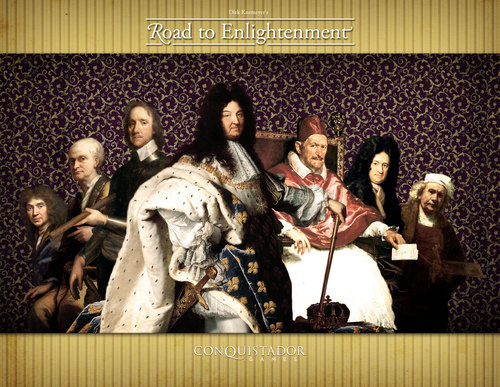
In this Tuesday's edition of our "After School Special", we broke out the 2012 release, Road to Enlightenment.  My buddy Glenn Weeks had picked this up at Prezcon this past year, and wanted tot get it to the table for a try.  We were joined by Paul O., Brian G., Brian D. and Stacy.  In RTE, which can handle up to 7 players, you take on the role of the monarch of one of the great European powers of the 17th century - England, France, Spain, Russia, Sweden, Poland or Austria.  Your goal is to be "recognized as the most prestigious monarch by producing the most admired art and culture, lead the continent in scientific innovations, spread or resist the spread of Catholicism, and attempt military expansion beyond your historical borders."  The way you do this is to collect the cards of important historical figures - "luminaries" - and play them for either the effect printed on their text, or for their values in various categories such as art, science, warfare, etc.


If you look carefully...Poland has invaded Russia
Despite the map of Europe, this game at it's heart, is a deck building game.  And that's where I started to have a bit of a problem with it.  Now, let me explain a little more...at the beginning of the game, you picked 3 "favorites" who would occupy special positions in your deck, essentially being available every turn.  After that, we all drafted 10 figures form the "normal" luminary decks.  These "normal" luminaries when played could either be returned to the draw decks, or "exhausted" to your personal discard pile...which means they would eventually make it back into your active hand.  The game played out in fairly typical deck-building fashion, playing cards to your strengths, and attempting to make your deck more efficient by weeding out the cards in your deck that were of little to no use to you.

Peter the Great...he's a bit awkward
Now, each leader has a benefit, a negative, and a once-per-game ability.  I was playing as Russia, and my benefit was +1 prestige (VP) per turn that I led in either science or art, my weakness was "awkward", which gave me negatives when negotiating with other countries, and my once-per-game action was to be able to advance 2 spots in either the science or art track.  Bearing this in mind, I went heavy on science and art luminaries.  This worked well for me, as I was able to quickly take the lead in science, and gain 1 VP per turn for something like 7 turns in a row.  Just when they caught me in science, I went ahead in art.  No one else scored points during the game, it was all end-game scoring.  I was somewhat worried when Brian, playing Poland, conquered  two of my cities (-2 per city for me), and Stacy cut a swath through central Europe, conquering 5 cities (worth 1 point each).  In the end, I had a bit of a runaway victory, based mostly on my mastery of art and science (in addition to scoring in-game, I was first in art at game end, and 2nd in science, which gave me points).

Beware the "Halifax Hammer"
Now, I really have not explained much of the nuances of the game, or even many of the actual rules.  I don't really want to get into the meat of the rules here, I'd rather talk about, despite my victory, why I'm really ambivalent about this game in general.  And I have two words for that - Deck Building.  I am not a fan of deck building games.  The few times I have tried that most popular of deck builders - Dominion - I have come away unimpressed.  I have felt though, that due to the popularity of deck builders, I must be missing something.  At Prezcon 2012, I gave A Few Acres of Snow a shot - I was particularly eager to try that, as I had heard it referred to several times as "the deck building game for people who don't like deck building games".  Again...meh.  Of course, it did not help, that right before the tournament, the GM announced "Everyone that wants to play needs to realize this is a broken game" - basically, with competent play, the British player is unstoppable - the "Halifax Hammer".  I'm also not a big fan of Race for the Galaxy, although I'm not sure that really qualifies as a "deck builder".  Interestingly, I do enjoy San Juan, the card game variant of Puerto Rico.  And, as mentioned before, I really enjoy a good game of Citadels.  But I think I'm safe in saying that Citadels is not a "deck builder". 


The Granddaddy of deck builders
So, what's my beef with deck builders?  Honestly...I'm not sure.  I think part of is the fact that veterans of the game have such an advantage over newcomers.  That's true to varying degrees in most games, but in deck builders, the way you build your "engine" with how various cards interact seems key.  A newbie, with no experience stands virtually no chance against an experienced player.  Also, I feel that in a lot of deck builders, there is very little interaction among the players.  Now, A Few Acres of Snow and RTE try to overcome this by having a map, and adding ways to "attack" fellow players...but still, it's not quite there.  Some of it may come from the frustration of not having the specific cards available when you need them, or being limited in your actions - "oh, I could use this card for it's text...but I need to use it for it's gold value in order to pay upkeep this turn.  Grrr."  I also don't like, the "surprise" element that sometimes happens.  You spend several turns gathering the correct cards together in your hand, only to play them and have them negated by some card an opponent plays that you had no idea existed.  Perhaps that goes away with experience in a game.

So, those are a few thoughts.  It could be as simple as "deck builders are just not for me"...with no particularly logical reason other than that.  As for RTE...I would certainly play it again, if our group really wanted to, but it's not at the top of my list (did I mention it took us 3.5 hours to play just 2/3 of the game - although with experience that should speed up).  Fans of deck builders may enjoy it...I would rate it higher than A Few Acres of Snow, simply for the fact that it can hold up to 7 (and likely 8 with the future expansion).

Thursday, April 4, 2013

Sea Monsters, 17th Century Farming and Citadels

Well, once again we had our weekly Tuesday night gaming.  This week there was 5 of us - Brian G., Mike R., Tracy, Tom and myself.

That sea monster in the lower right just ate my ship  :(
Tom was running late, so we started - like last week - with a game of Tsuro of the Seas.  Tracy had seen us finish up our game last week, but had not played.  Once again, we opted to not play with the Sea Monsters, so it was just "regular" Tsuro.  With only 4 players, and a 7x7 grid...I'm not sure that the game is terribly exciting.  We all spent the first 75% of the game away from each other until of course the tiles forced us together.  I was the first one out, followed by Tracy, and Brian finally won...and once again we nearly filled the board with tiles.  Tom arrived near the end, and we decided to play another game, and this time we added the monsters.  It's certainly a more tense game, with the random luck factor added in.  We played it correctly this time around (I think), so there was less fiddleness, but I have to say that I'm still not sold on the monsters.  It just seems like too much luck.  Maybe if we took out one or two...we started with 5 in our 5 player game.  On the other hand, as I mentioned, it does create some tense moments.  Brian was surrounded by two monsters at one point, and had to survive everyone's dice rolling until it came to his turn again.  Not only did he survive...he went on to win the game...again.

Little sheep...where are your boar and cattle buddies?
I had brought a few games that hadn't made it to the table in a while...and when Tom got there, he immediately zeroed in on my copy of Agricola.  This, of course, is one of the classics of the eurogame genre, but it's not necessarily for beginners.  Tom had heard about the game, but had yet to play it.  Tracy also had never played it.  Bearing that in mind, we opted for the "family game" where we played without occupations and minor improvements.  I immediately went down the path of expanding my home, in preparation for later family growth.  At one point, I noticed that the fireplaces and ovens were going fast, so I grabbed one before there were none left to be had.  I had also gathered enough clay to upgrade my house.  I was gathering a lot of resources, but I wasn't actually putting anything on my farm.  No animals, wheat or veggies.  I managed to fence in a nice 3X2 pasture at one point and got some sheep going, and also managed to purchase the well.  I never got my food engine going so that I was comfortable adding another family member.  I made a terrible mistake at one point with wood, passing on building more fences because I wanted to gather more wood to build an even larger pasture.  I completely missed the fact that I didn't have enough fence pieces left to build that larger pasture...and had to resort to filling squares with stables.  Brian was the only person to perform family growth fairly early in the game, but he also missed the opportunity to get anything that could cook animals...so he had feeding problems, and had to take a begging card.  I thought this would hurt him...but in the end he won by 9 points.  He had 28, Mike had 19, I was at 18 and Tom and Tracy were in the 11-12 area.  That extra worker really made the difference for Brian, even though he had to feed him.

I've been torn in the past about occupations and minor improvements.  In some respects I feel like it's too much.  But I have also been in the position many times of teaching the game to new players, so we default to the family game.  I now wonder if that's the smart thing to do.  I am wondering if the family game is harder than the regular game, in the sense that you don't have those extra cards to help get your production engine going.  In the family game, it's hard to keep your family fed each turn, and actually do things on your farm.  So, in the future, I think I may lean towards playing with the cards, even with new players.

I'm the Warlord.  Or I would be, if I hadn't been assassinated.
Last but not least was a game of Citadels.  This game has become our go-to for the last year or two as a end-of-the-night game.  Especially at conventions, where it's not unknown to be playing Citadels at 1 or 2 AM.  Somehow we didn't break it out at Prezcon, though, and it's been a while since we've played it after work.  I had been sitting between Tom and Tracy, and I had the uncomfortable moment where Tom insisted that they had played this game before, and Tracy absolutely denied it.  However, it got a lot more uncomfortable when we started playing, as I kept getting assassinated.  Four times, I believe, three of them in a row.  There's a number of people that don't like this game because of the fact that you can get assassinated or robbed quite a bit.  On Tuesday, it was my turn in the barrel.  I really like this game as a 3-player, because you get two roles to play each turn, but I like it even with only one role each.  The people that tend not to like it seem to think that it's very random, but I disagree.  This game is all about getting in your opponents heads...and figuring out which role they've picked, and making them think you've picked a different role than you really have.  Unfortunately, we did miss one rule in the game, as Tom declared victory, we noticed that he had 3 of the same buildings in his "citadel"...but hey...we should have caught that when he played the first duplicate.